

The importance of compliant labeling lies in its legal status under U.S. law. Labels function as legally binding documents rather than promotional materials.
Non-compliance exposes firms to FDA warning letters, product seizures, mandatory recalls, import refusals, civil penalties, or criminal prosecution pursuant to 21 U.S.C. §333.
Regulatory authority governing dietary supplement labeling originates within several federal statutes and regulations.
The Dietary Supplement Health and Education Act of 1994 established the modern framework for supplements. The Federal Food, Drug, and Cosmetic Act provides the FDA enforcement authority.
Nutrition Labeling and Education Act of 1990 governs nutrition disclosures and claims. FDA implementing regulations appear in 21 CFR Part 101, addressing labeling requirements and 21 CFR Part 111 governing current Good Manufacturing Practices.
Regulatory Framework for Dietary Supplements

Federal law establishes a distinct category for dietary supplements that separates these products from conventional foods and pharmaceutical drugs.
Statutory definition controls formulation, presentation, labeling, and enforcement treatment.
FDA defines a dietary supplement under Section 201(ff) as a product intended to supplement the diet and containing one or more dietary ingredients.
Qualifying dietary ingredients include vitamins, minerals, herbs, botanicals, amino acids, and other substances intended for ingestion.
Acceptable dosage forms include tablets, capsules, powders, softgels, and liquids.
Products presented as conventional foods, beverages, or sole meal replacements fail to meet statutory criteria and lose dietary supplement status.
Key classification limits arise directly within the statutory definition and shape regulatory exposure. Classification hinges on several mandatory conditions:
- Product must supplement the diet rather than replace meals
- Product must contain a qualifying dietary ingredient
- Product must be intended for ingestion
- Product must avoid representation as conventional food
Regulatory status places dietary supplements within the food category rather than drugs.
FDA does not conduct pre-market review or approval of dietary supplement labels, formulas, or marketing materials prior to commercial distribution.
Legal accountability for compliance rests entirely with manufacturers, packers, and distributors.
Products bearing labels that fail to meet statutory or regulatory requirements are considered misbranded and subject to FDA enforcement action without advance notice.
Mandatory Label Elements
Federal labeling rules require specific information to appear on every dietary supplement label. Each element serves a legal disclosure purpose and must follow strict placement and formatting rules.
Statement of Identity

Statement of identity communicates product classification and must appear prominently on the Principal Display Panel.
Required terminology must include the phrase “Dietary Supplement” following the name of the dietary ingredient or general product category.
Acceptable examples include “Calcium Dietary Supplement” and “Herbal Dietary Supplement.” Regulatory authority for statement of identity requirements derives from 21 CFR 101.3(g).
Placement and wording errors commonly result in misbranding determinations, especially when product names resemble conventional foods or drug products.
Net Quantity of Contents
Net quantity declaration informs consumers of package contents and must appear on the Principal Display Panel in a conspicuous location.
The declaration format depends on the product form.
Acceptable presentation methods include:
- Numerical count for capsules, tablets, soft gels, or gummies
- Net weight for powders
- Net volume for liquids
Examples include “60 Capsules” or “8 fl oz.” Omission or obscured placement frequently triggers enforcement scrutiny.
Supplement Facts Panel
Supplement Facts Panel serves as the central regulatory disclosure for dietary ingredients and must comply with detailed formatting and content specifications established in 21 CFR 101.36.
Panel must appear boxed, legible, and formatted according to FDA design standards.
Required disclosures include serving size, servings per container, dietary ingredient names, and amount per serving. Percent Daily Value must be listed for nutrients with established Daily Values. Additional labeling rules apply to specific ingredient categories.
Key technical requirements include:
- Ingredients without established Daily Values marked with a dagger symbol
- Corresponding statement indicating “Daily Value not established”
- Botanical ingredients identifying specific plant part used
- Folate expressed in micrograms Dietary Folate Equivalents with folic acid amount in parentheses
Failure to follow updated Daily Value units remains a common violation following FDA 2016 revisions.
Ingredient List
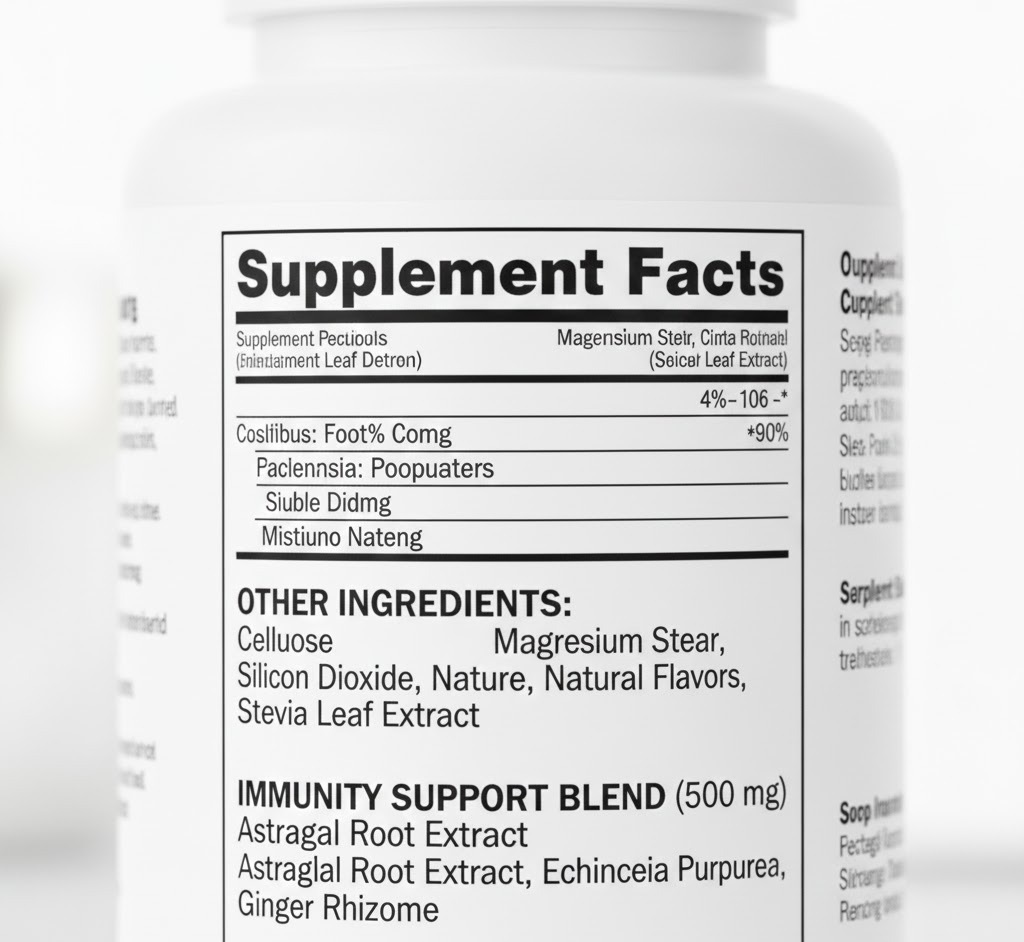
Ingredient list provides transparency for non-dietary components and must appear outside the Supplement Facts Panel under the heading “Other Ingredients.”
All excipients and processing aids must be listed in descending order of predominance by weight.
Covered ingredients include binders, fillers, coatings, flavors, sweeteners, preservatives, and color additives.
Proprietary blends require additional disclosures to balance trade secret protection with consumer transparency.
Required proprietary blend disclosures include:
- Proprietary blend name
- Total weight per serving
- Individual ingredients listed in descending order by weight
Individual ingredient weights are not required unless ingredient qualifies as a vitamin or mineral with an established Recommended Daily Intake.
Name and Place of Business
The label must identify the responsible firm involved in manufacturing, packing, or distribution.
Disclosure must include business name along with city, state, and ZIP code.
Street address omission remains permissible when address information appears in publicly available directories.
For example, a facility like Oates Ln access storage NSA Storage in Coachella can provide compliant storage space for firms requiring regulated access and storage of labeled dietary supplement products.
Post-market safety reporting requirements impose additional disclosure obligations.
The Dietary Supplement and Nonprescription Drug Consumer Protection Act of 2006 requires inclusion of a domestic mailing address or domestic telephone number to support adverse event reporting.
The Dietary Supplement and Nonprescription Drug Consumer Protection Act of 2006 requires inclusion of a domestic mailing address or domestic telephone number to support adverse event reporting.
Warning Statements and Allergen Declarations

Certain dietary ingredients and dosage forms trigger mandatory warning statements designed to mitigate foreseeable risks.
Warning requirements depend on formulation, ingredient profile, and target population.
Common mandatory warnings apply to:
- Softgel dosage forms presenting choking risk
- Iron-containing supplements posing accidental overdose risk to children
Food allergen disclosure obligations apply to dietary supplements as food products.
The Food Allergen Labeling and Consumer Protection Act requires declaration of major food allergens using a “Contains” statement placed immediately after the ingredient list.
Sesame qualifies as a major food allergen effective January 1, 2023 pursuant to the FASTER Act.
Optional and Regulated Label Claims
Label claims remain highly regulated due to their influence on consumer perception and disease-related implications. Claim category determines permissible wording and regulatory obligations.

Structure Function Claims
Structure function claims describe support for normal body structure or function without referencing disease states. Acceptable examples include statements such as “Supports immune health.”
Claims implying diagnosis, treatment, mitigation, or prevention of disease are prohibited and result in drug classification.
Mandatory conditions apply to structure function claims and must be satisfied simultaneously:
- Claim must relate to normal structure or function
- Claim must avoid disease references
- Claim must include required disclaimer\
- Claim must be submitted to FDA within required timeframe
DSHEA disclaimer must accompany all structure function claims and state that FDA has not evaluated the statement and that product is not intended to diagnose, treat, cure, or prevent any disease.
Notification must be submitted to FDA no later than 30 days after initial marketing.
Health Claims
Health claims describe a relationship between a nutrient or substance and reduced risk of a disease or health-related condition.
Authorization requires FDA approval through regulation based on significant scientific agreement.
Qualified health claims require specific qualifying language to reflect scientific uncertainty.
Approved examples include statements addressing sodium intake and reduced risk of high blood pressure.
Nutrient Content Claims
Nutrient content claims characterize nutrient levels using descriptive terms such as “High,” “Good Source,” or “Excellent Source.”
Claims must meet FDA-defined quantitative thresholds tied to Daily Values.
Term “High” requires provision of at least 20 percent of the Daily Value per serving.
Improper nutrient content claims frequently trigger enforcement action due to mathematical inaccuracies or outdated Daily Values.
Label Formatting Layout and Typography Requirements
Formatting rules govern readability and uniformity across dietary supplement labels. Supplement Facts Panel must appear boxed with bold headings and consistent formatting.
Typeface must remain uniform and legible across all required information. Minimum font height equals one-sixteenth inch measured using lowercase “o” height.
The Information Panel must present required disclosures without interruption by promotional material or graphics. Placement must occur adjacent to the Principal Display Panel when space permits.
Frequent formatting failures cited by FDA include poor color contrast, decorative elements obstructing text, missing borders, incorrect sequencing of disclosures, and failure to use mandated typography standards.
Common Compliance Issues and Pitfalls

FDA enforcement data identifies recurring compliance failures across dietary supplement products.
Disease claims implying treatment or prevention remain the most common violation.
Absence or modification of the required DSHEA disclaimer continues to trigger warning letters.
Continued use of outdated Daily Values or obsolete nutrient units persists after regulatory updates.
Improper Supplement Facts formatting and allergen omissions generate consistent enforcement activity.
Enforcement consequences escalate progressively and may include multiple actions. Outcomes commonly involve:
- Publicly posted FDA warning letters
- Product seizures or mandatory recalls
- Import refusals for foreign-manufactured products
- Civil penalties or criminal liability under Section 333 of the Federal Food Drug and Cosmetic Act
Recent enforcement action occurred in 2024 when Defyned Brands pled guilty to distributing misbranded dietary supplements and paid 4.5 million dollars in forfeitures.
Summary
FDA-compliant dietary supplement labeling serves as a legal prerequisite for lawful marketing in the United States.
Errors involving format, substance, or claims expose firms to significant regulatory action.
Manufacturers should rely on FDA labeling guidance documents, conduct routine label reviews to address regulatory updates such as allergen expansions and Daily Value revisions, and maintain strict separation between permissible structure-function claims and prohibited disease claims.
Accurate labeling protects brand reputation, consumer safety, and uninterrupted access to the U.S. dietary supplement market.