

Leg training often revolves around machines like leg presses, leg extensions, and Smith squats. Popularity does not equal effectiveness.
Machine-based movements lock the body into fixed paths, reduce stabilizer involvement, and limit the strength that transfers to athletic movement.
Stronger legs come from exercises that demand balance, coordination, and full muscle recruitment.
The seven alternatives below challenge the lower body harder, build usable strength, and promote healthier joints.
1. Bulgarian Split Squats (Resistance or Dumbbell)
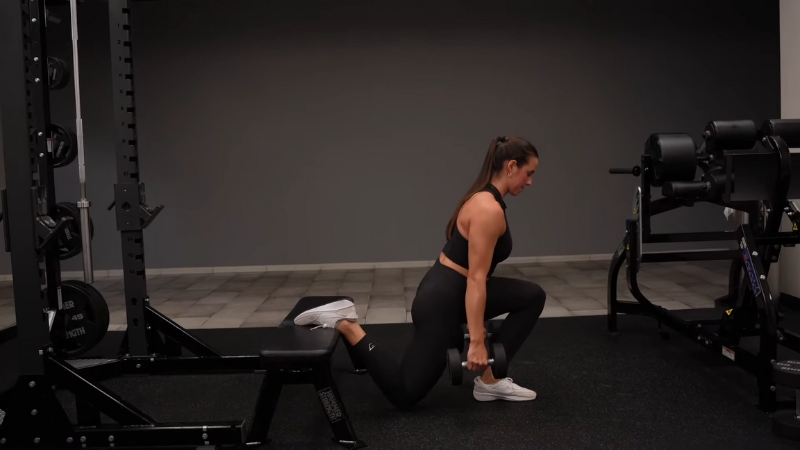
Bulgarian split squats load one leg at a time, forcing quads, glutes, and stabilizers to work harder than most machine exercises.
Single-leg loading increases balance demands, driving higher core activation and improved hip control that carries into athletic movement and compound lifts.
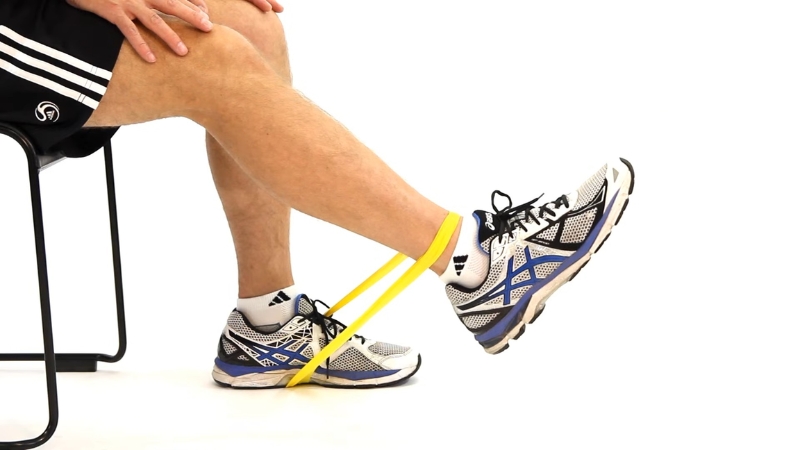
Resistance bands change muscle recruitment by pulling the knee forward and increasing constant tension on the glutes.
Movement mechanics shift closer to a squat pattern rather than a lunge, allowing aggressive quad loading without excessive knee irritation.
Several machine staples become redundant once Bulgarian split squats are trained consistently, including:
- Leg extensions that isolate quads without joint stability
- Leg presses that remove balance and coordination
- Smith squats that restrict the natural bar path and foot mechanics
Reverse lunges already reduce knee strain compared to traditional bilateral squats.
Bulgarian split squats push adaptation further by increasing unilateral load, time under tension, and positional strength at deeper knee angles.
Progression remains simple and effective using:
- Dumbbells for accessible loading
- Barbells for maximal strength focus
- Resistance bands for constant tension and joint-friendly overload
2. Jump Squat to Squat Hold
View this post on Instagram
Jump squats activate fast-twitch muscle fibers responsible for power, speed, and rapid force production.
Immediate transition into a squat hold creates metabolic stress that extends muscle fatigue well past the explosive phase.
Deceleration strength and joint stability improve as muscles absorb force and maintain position under fatigue.
Athletic performance benefits extend into sprinting, cutting, and landing mechanics.
Machine-based leg presses and calf raises fail to train explosive output or stabilization demands.
Jump squat combinations address both qualities through coordinated movement and sustained tension, making them excellent for athletes from all sports, including those training for ski lessons, where explosive power, joint control, and balance are essential on the slopes.
Advanced variations increase difficulty by introducing instability, which drives:
- Higher stabilizer activation
- Greater proprioceptive demand
- Increased fatigue without heavier loading
3. Romanian Deadlifts (RDLs)
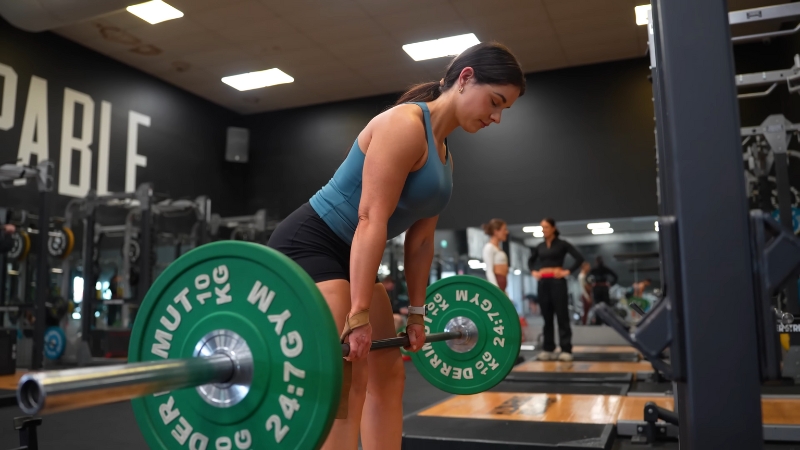
Romanian deadlifts strengthen hamstrings, glutes, and spinal stabilizers in one coordinated hinge pattern.
Posterior chain engagement improves posture, sprint mechanics, and force transfer across nearly every lower-body movement.
Seated hamstring curls isolate knee flexion while ignoring hip extension and trunk stability.
RDLs correct that gap by training hamstrings under load while maintaining a neutral spine and active core.
Single-leg variations introduce additional demands that bilateral lifts cannot replicate.
Benefits include:
- Exposure of left-to-right strength imbalances
- Increased ankle and hip stability
- Higher neuromuscular control under load
Posterior chain strength developed through RDLs supports lifting efficiency, running mechanics, and daily movement far more effectively than machine-based alternatives that remove balance and coordination.
4. Front Squats or Goblet Squats
Front-loaded squats shift stress toward the quads while encouraging a more upright torso.
Reduced forward lean lowers spinal compression, allowing heavy quad training with less lower back fatigue.
Front squats reinforce proper bracing and posture under load, while goblet squats provide an accessible option for higher volume work or technical refinement.
Load placement forces continuous core engagement throughout the set.
Machine-based squat variations limit joint freedom and stabilize the load artificially. Free-weight squats restore natural movement patterns by allowing:
- Ankles, knees, and hips to self-organize
- Stabilizers to assist actively
- Bar path adjustments based on individual structure
Tempo goblet squats and banded pause squats increase time under tension during the most demanding joint angles, driving hypertrophy and conditioning without excessive external load.
5. Step-Ups to Wall Sit Combo
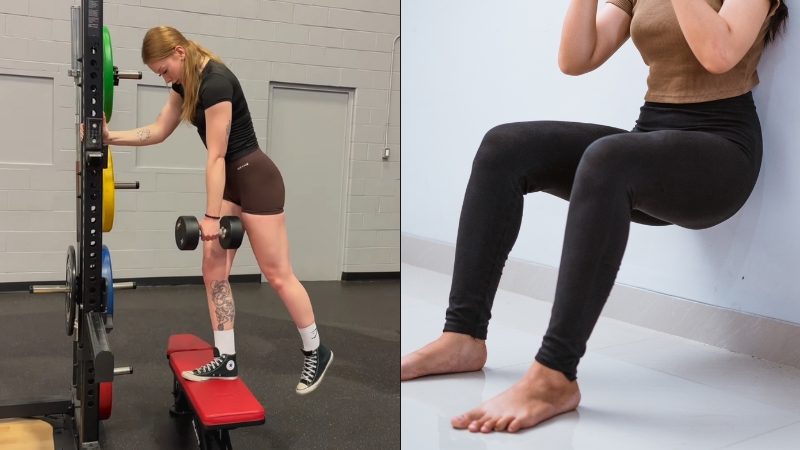
Step-ups develop unilateral strength through hip and knee extension while challenging balance and coordination.
Higher box heights increase glute and hamstring involvement, especially during controlled eccentrics.
Wall sits immediately follow step-ups to extend quad fatigue under isometric tension.
Muscular endurance improves rapidly when sustained holds are performed after dynamic work.
Machine alternatives fail to replicate this layered stimulus, as step-ups paired with wall sits create:
- Dynamic power output
- Prolonged quad tension
- Continuous cardiovascular stress
Loading options remain flexible. Dumbbells increase mechanical demand, while a knee drive at the top of each step-up adds rotational stability and trunk control.
6. Sissy Squats
@kellylmatthews Coach Kelly Cues: Sissy Squats Full pr0gram ïn b!0 #sissysquats #coaching #strengthtraining ♬ Make Me Feel – oskar med k
Sissy squats place extreme demand on the quads using body positioning rather than external load. Lever mechanics amplify tension even at low resistance levels, making bodyweight versions highly effective.
Joint stabilizers remain active throughout the movement.
Knees, ankles, and hips must constantly coordinate to control the lean-back position, improving resilience and positional awareness.
Traditional leg extension machines isolate quads in a fixed seated posture and often increase knee discomfort.
Sissy squats train quad strength dynamically while reinforcing balance and joint control.
Progression strategies allow long-term overload, including:
- Weighted vests for added resistance
- Slow eccentrics to extend tension duration
- Dedicated benches for consistent positioning
7. Lateral Lunges or Cossack Squats
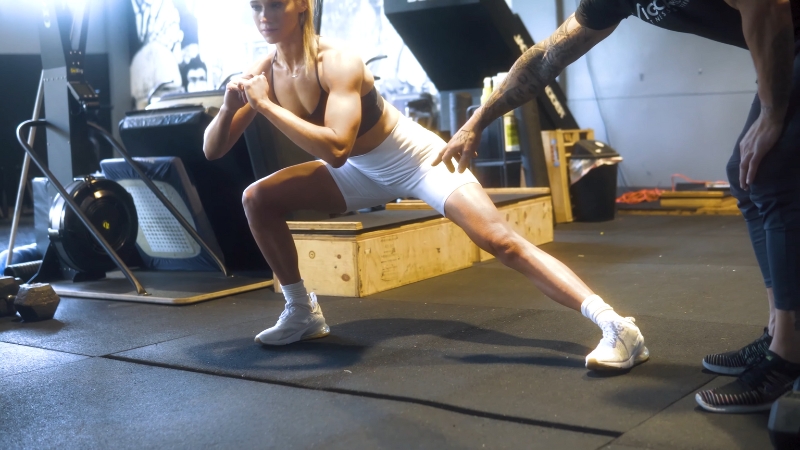
Lateral lunges strengthen inner and outer thighs while improving hip mobility and frontal-plane control.
Side-loaded movement forces hips, knees, and ankles to stabilize under shifting center of mass, building strength that carries into sport and daily movement.
Side-to-side patterns receive focused training, often absent in linear leg routines.
Muscles responsible for deceleration and lateral push-off activate more aggressively compared to forward-only exercises, improving coordination and reducing imbalance risk.
Hip adduction and abduction machines isolate muscles without functional context or joint integration.
Lateral lunges demand full-leg coordination while reinforcing joint control under load and changing angles, creating strength that translates into cutting, stepping, and balance correction.
Cossack squats push adaptation further by increasing depth and range of motion.
Deep hip flexion challenges mobility and strength simultaneously, forcing the working leg to support load while the non-working leg assists balance and positioning.
Lower body control improves progressively as depth increases and pauses are introduced at the bottom.
Several execution details enhance effectiveness:
- Controlled eccentrics to reinforce hip stability
- Upright torso to maintain joint alignment
- Active foot pressure to protect knees and ankles
Loading options maintain joint-friendly mechanics while allowing progression:
- Kettlebells for counterbalance and improved depth control
- Bodyweight for mobility-focused sessions and technique refinement
Regular use of lateral lunges or Cossack squats fills a major gap left by traditional leg training and builds strength across movement angles that machines fail to address.
Build Smarter Legs Without the Machines
Serious leg strength does not require complex machines or crowded gym floors.
Functional, compound movements challenge more muscle tissue, improve balance, and reduce unnecessary joint strain.
Seven alternatives outlined above outperform machine-based routines by demanding coordination, stability, and full-body engagement.
Rotating these exercises into weekly training builds stronger legs that perform better during lifting, sports, and daily activity.