


When it comes to athletic performance, the focus often lands on training volume, lifting numbers, or running pace. But there’s a quiet player working behind the scenes every single time you move: ATP, or adenosine triphosphate. It’s not flashy, and it won’t show up in your workout selfies, but it’s the fuel that powers every jump, sprint, rep, and play.
And like any fuel source, it runs out – fast. That’s where ATP recovery cycles come in. If you’ve ever felt your power fade between sets or noticed your legs dragging during a second sprint, that’s ATP depletion talking. Knowing how your body refuels ATP can change the way you train, recover, and compete.
Let’s get into the details, so you can start using your energy systems more efficiently – and keep the edge over your competition.
ATP 101: What It Does and Why You Burn Through It So Quickly
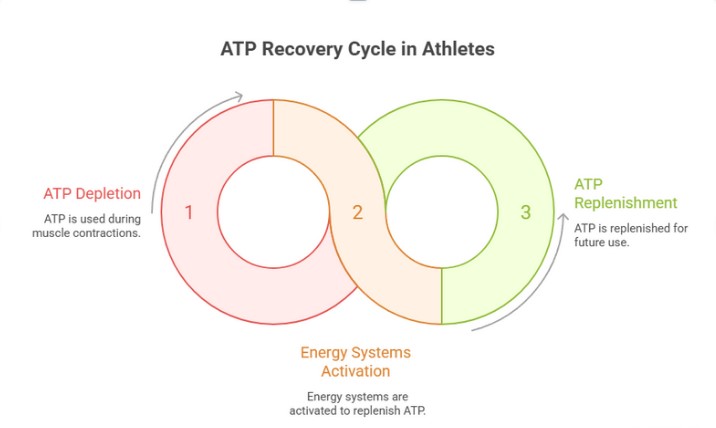
ATP is the molecule your cells use to do just about everything. For athletes, its most important job is fueling muscle contractions. Every time you contract a muscle – whether you’re pushing a sled, sprinting 40 meters, or performing a clean and jerk – ATP is being broken down and spent.
But the catch? Your muscles only store enough ATP to last a few seconds at full tilt. Once those stores run out, your body has to make more. That’s where energy systems step in.
The Three Main ATP Systems
Your body uses three main pathways to regenerate ATP:
| Energy System | Duration | Fuel Source | Best For |
| Phosphagen (ATP-PC) | 5 to 15 seconds | Stored ATP and creatine phosphate | Sprints, heavy lifts, throws |
| Glycolytic | 30 seconds to 2 minutes | Glucose (anaerobic) | 400m run, circuit training |
| Oxidative | 2+ minutes | Carbs, fats, and protein (aerobic) | Long runs, cycling, distance swimming |
Each one kicks in based on how intense your effort is and how long you’re going. The phosphagen system is lightning fast but burns out in seconds, which makes recovery essential if you want to perform repeated high-power efforts.
The ATP-PC System
When you’re at max effort – exploding off the blocks in a sprint or pulling a max deadlift – it’s the ATP-PC system doing the heavy lifting.
It uses ATP and a second molecule called creatine phosphate (CrP), which hangs out in your muscles ready to donate a phosphate group and help rebuild ATP in real time.
But after just 5 to 10 seconds, those reserves are tapped.
At that point, your body slows down until it can replenish those stores. The better your recovery cycle, the faster you can get back to peak power.
Timing and Phases
CrP and ATP recovery happen in phases. It’s not instant, and the speed depends on a few things like oxygen availability, muscle fiber types, and how hard you just went.
Recovery Timeline (Based on Research)
| Time After Effort | CrP Recovered (Approx.) |
| 90 seconds | ~65% |
| 6 minutes | ~85% |
| 13.5 minutes | ~95% |
There’s an initial fast recovery in the first couple of minutes, followed by a slower phase that finishes the job.
Muscle pH also matters. If your workout pushed lactate and acidity levels through the roof, CrP recovery slows down. That’s because acidic environments interfere with the enzymes responsible for making more ATP.
Why It All Matters for Performance

Incomplete ATP recovery leads to more than just a little fatigue. You start to see real consequences in how you move and what you can accomplish during workouts or competition.
Some of the Key Problems
- Lower power output in repeat efforts (e.g., slower sprints or failed lifts)
- Higher perceived fatigue because your body works harder with less energy
- Increased injury risk if you push tired muscles that aren’t ready
Picture a basketball player trying to explode off the floor for a rebound after a few minutes of intense play. If ATP hasn’t been replenished, that vertical jump isn’t going to be the same.
Or imagine a sprinter trying to hold form on their fourth rep of 100 meters – without enough recovery, performance drops.
How to Help Your Body Recover ATP Faster

Knowing what’s happening at the cellular level is great, but you also need strategies you can actually use. Here’s what works:
1. Structure Rest Periods Wisely
The length of your rest between high-intensity efforts can make or break your next rep. The ATP-PC system needs more time than many think.
Guidelines
- 5–10 second sprints: Rest 2–3 minutes
- 30-second high-intensity intervals: Rest 5–10+ minutes
Stick to a work-to-rest ratio of about 1:10 for ATP-PC dominant training. So if you’re doing a 10-second hill sprint, rest for 100 seconds at minimum.
2. Choose Passive or Active Recovery Based on the Goal
- Passive recovery (sitting, lying down, light standing) helps restore ATP and CrP faster during short rest intervals. Best for short sprints, lifts, or throws.
- Active recovery (slow jog, cycling, walking) helps clear lactate and reduce muscle acidity. More useful after glycolytic training or when prepping for endurance events.
For example, a sprinter doing 60m sprints might benefit more from passive rest between efforts, while a soccer player could use light jogging to simulate in-game demands.
3. Train the Energy System Itself
Your body adapts when you challenge it correctly. Want better ATP-PC recovery? Target it in your workouts.
Example training block for explosive athletes:
- 6-8 reps of 10-second sprints at max effort
- 5–3 minutes rest between each
- Repeat 2–3x per week
This builds your creatine phosphate stores and makes your body more efficient at replenishing ATP.
HIIT also helps. Intervals at 90–100% of VO2max with rest periods challenge both glycolytic and oxidative systems, which feed into better ATP recovery overall.
Support Recovery with Nutrition and Supplements

Fueling right is just as important as training right. Recovery starts in the gym but finishes in the kitchen.
Key Nutritional Supports
- Carbs: Replenish glycogen stores that back up longer energy systems. Think rice, oats, fruits, or potatoes post-workout.
- Protein: Repair muscle and support enzyme production for better energy turnover. Aim for 20–30g post-session.
- Creatine Monohydrate: Well-researched for increasing CrP stores. A standard loading phase (10g/day for 2 weeks) followed by 5g/day maintenance can boost recovery and high-intensity output.
- Magnesium: Involved in ATP synthesis and muscle relaxation. Found in greens, seeds, or via supplements (250–350mg per day).
Periodize for Long-Term ATP Gains
You can’t go hard all year without paying the price. That’s where smart programming comes in.
Sample Periodization
| Athlete Type | Training:Rest Cycle |
| Advanced (age < 35) | 3 hard weeks + 1 deload week |
| Beginner or older | 2 hard weeks + 1 deload week |
Tools like TrainingPeaks recommend a Chronic Training Load (CTL) ramp rate of 3–8 per week. That means you’re progressing but not pushing your nervous system or ATP reserves over the edge.
Different Sports, Different Recovery Demands

Each sport has a unique fingerprint when it comes to energy use. Here’s how ATP recovery fits into a few of them:
| Sport | Primary Energy System | Recovery Focus |
| 100m Sprint | ATP-PC | 2–5 minutes passive rest between reps |
| 400m Run | ATP-PC + Glycolytic | Active rest, 3–5 minutes between efforts |
| Soccer or Hockey | ATP-PC + Glycolytic | Interval recovery; simulate game patterns |
| Distance Running | Oxidative | Nutrition + sleep; glycogen-focused recovery |
| Olympic Weightlifting | ATP-PC | Full rest (3–5+ minutes) between heavy lifts |
Tailor your recovery to your sport. Don’t copy a marathoner’s plan if you’re training for a 60m dash.
Don’t Skip the Basics
No supplement or rest period can make up for poor sleep or sloppy nutrition.
- Sleep: Aim for 7–9 hours. Deep sleep is where a lot of the muscle repair and hormonal rebalancing happens. It’s your overnight recovery protocol.
- Post-Workout Meal: A good combo is something like grilled chicken with sweet potato, or a protein shake with fruit. Get both carbs and protein within an hour of intense training.
Consistency here makes a bigger impact on recovery than any high-tech gadget.
Make Recovery Personal
View this post on Instagram
Every athlete has different recovery needs. What works for your training partner might leave you drained. Listen to your body.
Practical tools to track it:
- Heart Rate Variability (HRV) apps or wearables
- Session RPE (Rate of Perceived Exertion) logs
- Resting heart rate trends
- Performance drop-offs across reps or sessions
If your second or third effort is consistently weaker than your first, it’s probably time to stretch your rest periods – or reassess your weekly load.
Final Thoughts
ATP recovery cycles aren’t something only sports scientists should care about. They’re baked into every workout you do. If you want to run faster, lift more, or outlast your opponent, you’ve got to pay attention to how your body refuels between efforts.
A few things to remember:
- Give yourself 2–5 minutes of rest for max-effort sprints or lifts.
- Use active recovery to clear lactate, but passive rest for short bursts.
- Include HIIT and focused sprint work to build better ATP-PC recovery.
- Support recovery with creatine, carbs, and high-quality sleep.
- Periodize training to avoid digging into a fatigue hole.
Small adjustments to your training and recovery schedule can lead to noticeable gains in performance. It’s not about working harder – it’s about recovering smarter. ATP is your energy engine. Keep it running clean.